Comparison, updated October 2026
Looking for a Symbolab alternative?
Symbolab is one of the most capable math tools around. It is built on more than 500 calculators and goes well past most phone apps, into matrices, series and differential equations.
It is also built for typing, and the detailed explanations need a subscription. If you would rather point your camera and get every step explained, this page compares Symbolab with MathScans as fairly as we can.
Disclosure: MathScans is our own app.
Every Symbolab fact on this page comes from its App Store listing, checked in October 2026. Symbolab is genuinely ahead on advanced topics, and we say so below.
MathScans vs Symbolab at a glance
| MathScans | Symbolab | |
|---|---|---|
| Free version | None. 3-day trial on the monthly plan | Yes, with basic steps |
| Detailed step explanations | On every solution | With a subscription |
| How steps are shown | Typeset, animated and read aloud in 19 languages | Written symbolic steps |
| Best input | Camera scan of print or handwriting | Typed, with a camera option |
| Subjects | Arithmetic to calculus, statistics and word problems | Pre-algebra to calculus, plus matrices, series and ODEs |
| Devices | iPhone, iOS 17 or later | iPhone, iPad, Android and web |
| Data used to track you | None declared | None declared |
| Price | $9.99/mo or $4.99/wk | Free basic steps, paid subscription |
| App Store rating | Too new to be rated yet | 4.6 from 26K ratings |
Symbolab details are from its US App Store listing and privacy label in October 2026. Listings change, so check before you subscribe.
Is Symbolab free?
Partly. The Symbolab app and website are free for answers and basic step-by-step solutions, across more than 500 calculators from algebra to calculus.
The paid subscription adds the more advanced steps and explanations. Prices vary by country and plan, so check the in-app price before subscribing.
So, like Photomath, Symbolab gives you a real free option. The question is whether its free steps go far enough on the problems you are actually stuck on.
Why people look for a Symbolab alternative
The first reason is input. Symbolab grew up on the web, where typing an equation with a full keyboard is quick. On a phone, the same equation means hunting for exponents, fractions and brackets on a small math keypad.
The second is the paywall. Symbolab's free tier gives basic steps, and its own listing says the more advanced steps and explanations come with a subscription.
The third is tone. Symbolab's working is thorough and notation-heavy, which suits confident students. When you meet a topic for the first time, plainer explanations can be easier to follow.
Typing a problem vs scanning it
Take an integral from a calculus worksheet. To type it on any phone, you need the integral sign, the exponent, a function with brackets and the dx, each from a different part of the keypad.
One slip, like a bracket in the wrong place, and the app solves a different problem from the one on your page. Scanning skips that step, as long as you check the problem it read at the top of the solution.
Typed, one key at a time
Scanned, one photo
∫ x² sin(x) dx
What MathScans does differently
Point the camera instead of typing
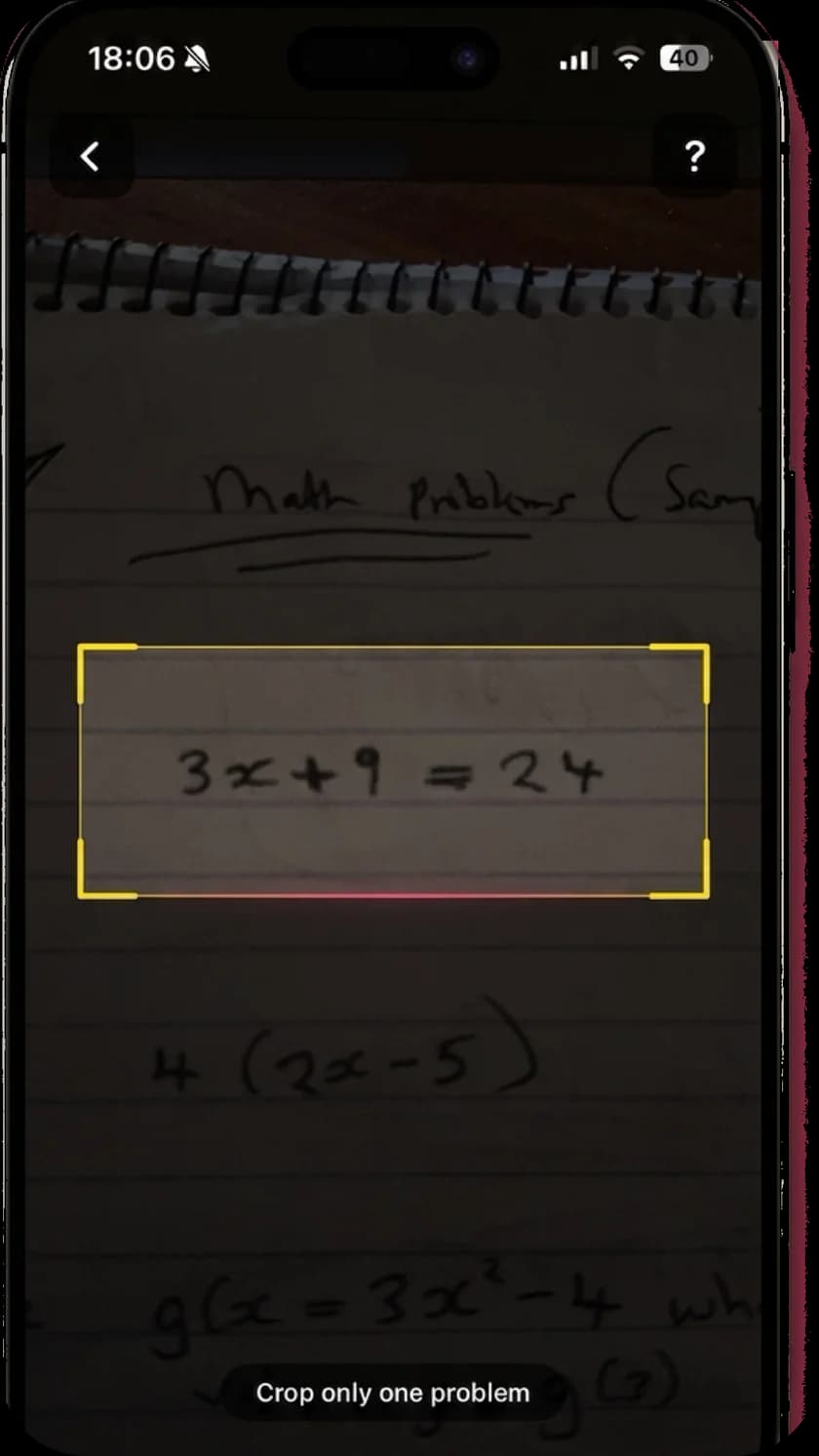
MathScans is built around the camera. Hold your iPhone over a worksheet or your own handwriting, and it reads the problem for you.
There is no math keyboard to learn and no brackets to balance. That matters most on a phone, where typing a long expression is the slowest part of the whole process.
Explanations in plain language
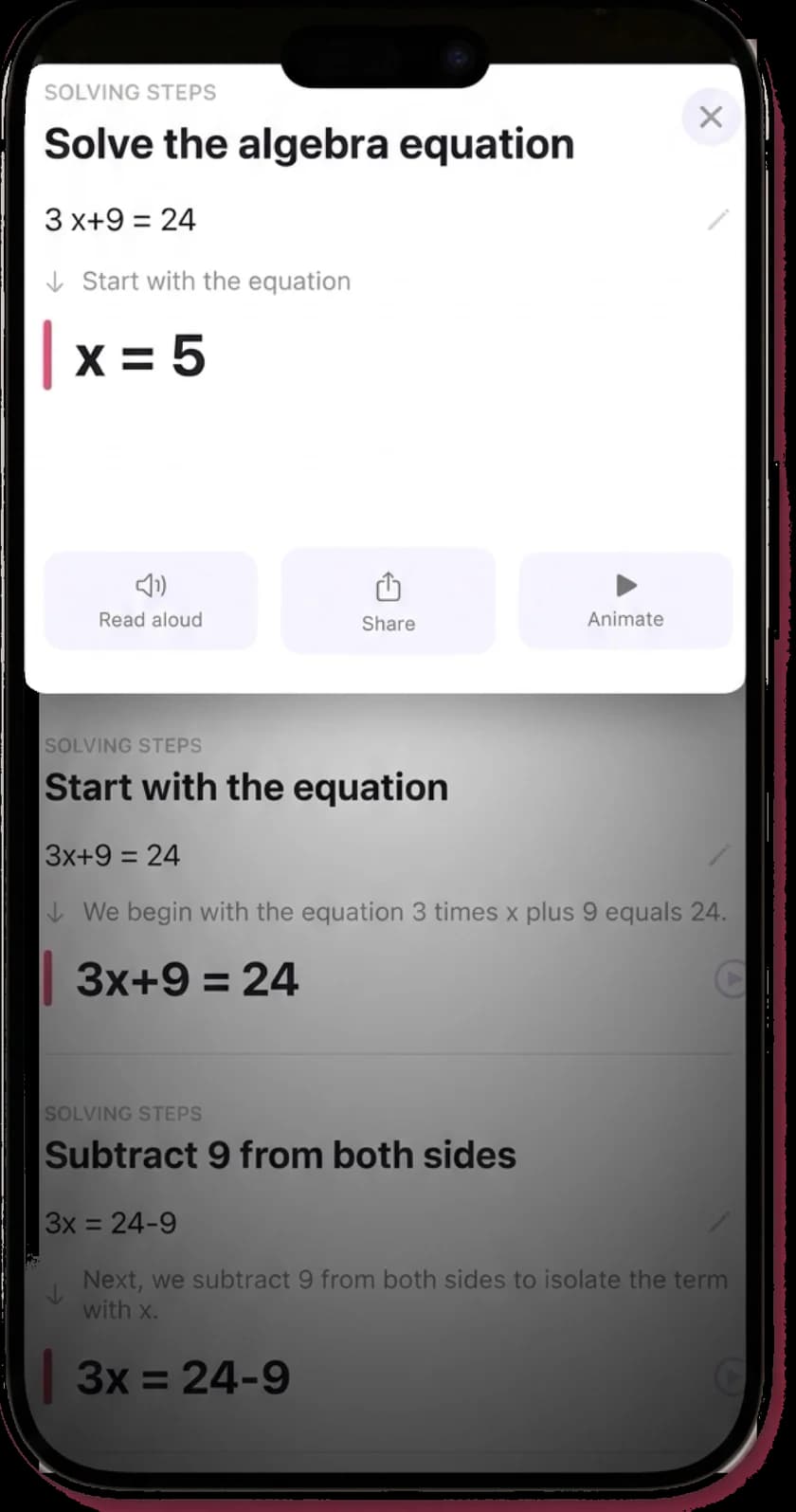
Each step names the operation in everyday words, then shows the equation after it. The aim is to explain the move, not just record it.
Every explanation is included on every solution. There is no basic tier with the detail held back.
Watch it and hear it
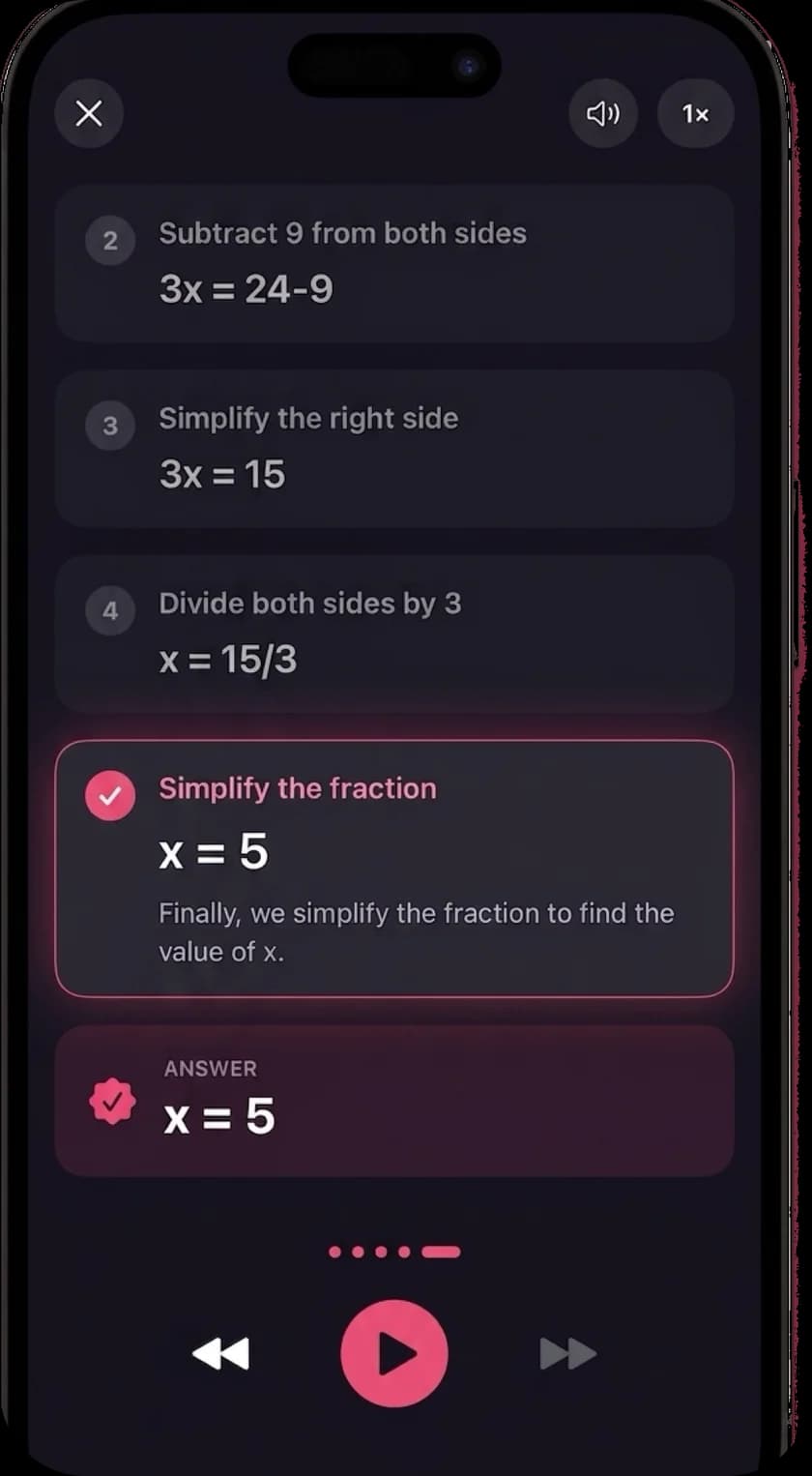
Press play and the solution walks through one step at a time. You can pause, go back or change the speed, like a short lesson on your own problem.
Every step can also be read aloud in any of 19 languages. That suits students who learn by listening, or who study math in a second language.
Where Symbolab is still the better choice
If your course goes past first-year calculus, Symbolab is ahead. Matrices, series, differential equations and Laplace transforms all have dedicated calculators there, while MathScans is designed for school math through early university.
It also runs on the web, iPad and Android, while MathScans is iPhone only. If you do most of your work on a laptop, a browser tab of Symbolab is hard to beat.
And it is free to start. If basic steps are enough for you, there is no reason to pay for anything, including MathScans.
Who should switch, and who should stay
Switch to MathScans if
- You would rather scan a problem than type it on a phone keyboard
- You want every explanation included without a basic tier
- You are learning a topic for the first time and want plain-language steps
- You learn better by watching and listening than by reading
Stay with Symbolab if
- You study beyond calculus, such as ODEs, Laplace transforms or series
- You work on a laptop, iPad or Android phone
- You are fluent in math notation and prefer to type exactly what you mean
- Free basic steps are enough for what you need
Other Symbolab alternatives worth knowing
Photomath, owned by Google, is camera-first like MathScans and includes basic step-by-step explanations for free. See our Photomath alternatives page for how it compares.
Mathway covers an even wider range of subjects, including physics, but keeps its steps behind a subscription. Our Mathway alternative page covers it, and the best math solver apps comparison puts all five side by side.
Gauth covers every school subject, including biology and chemistry, and adds human experts on its paid plan. It suits students who want one app for all their homework rather than a math specialist.
How to try it before you pay
Start the monthly plan, which comes with a 3-day free trial. Then scan a few problems you would normally type into Symbolab, ideally from your current homework.
Choose the ones that are hardest to type, such as fractions inside roots or long integrals. That is where scanning saves the most time, so check that the problem MathScans shows at the top of each solution matches your page.
Compare the explanations side by side and see which ones you could reproduce in a test. If MathScans does not help, cancel in your iPhone's Settings at least a day before the trial ends and you will not be charged.
Questions about Symbolab
- Is Symbolab free?
- Partly. The Symbolab app is free to download and gives free solutions with basic steps. More advanced steps and explanations need a paid subscription, according to its App Store listing.
- Is Symbolab accurate?
- Yes, it is widely used and has a 4.6 App Store rating from about 26,000 reviews. As with any solver, the result is only as good as the input, so check that the problem it read or you typed matches the one on your page.
- Which is better, Symbolab or Mathway?
- They suit different people. Symbolab is stronger for typed input and advanced topics like matrices and differential equations, and it gives basic steps for free. Mathway covers a broader range of subjects, including physics, but keeps its step-by-step working behind a subscription.
- What is the best Symbolab alternative?
- For free steps on a phone, Photomath. For the widest range of subjects, Mathway. For scanning a problem and getting every step explained, animated and read aloud on iPhone, MathScans.
- Can MathScans solve calculus problems?
- Yes. MathScans covers single-variable calculus, including limits, derivatives and integrals, along with algebra, trigonometry and statistics. It is designed for school math through early university, so for differential equations or Laplace transforms, Symbolab's dedicated calculators are the safer choice.
- Is MathScans free?
- No. MathScans needs a subscription: $9.99 a month with a 3-day free trial, or $4.99 a week. Every feature is included in both plans, and you can cancel any time in Settings.
Keep reading
- Best math solver apps comparedFive apps side by side, with the catch in each.
- Mathway alternativeWhen the steps are what you need, not just the answer.
- Photomath alternativesIs Photomath free, and which apps like it are worth paying for.
- Math app for calculusDerivatives, integrals and limits, step by step.
- Math scannerHow the scanner reads, crops and solves your problem.
- Math solver with stepsHow each step is explained, animated and narrated.
Scan it instead of typing it.
Try MathScans free for 3 days on the monthly plan. After that it is $9.99 a month or $4.99 a week. Cancel any time in Settings.