Calculus solver, on iPhone
Scan a derivative, integral or limit. See every step.
MathScans solves calculus from a photo of your problem, printed or handwritten. Each line names the rule it used and explains why it applies.
Below is a full worked integral, a limit, and an honest look at how the main calculus solvers compare.
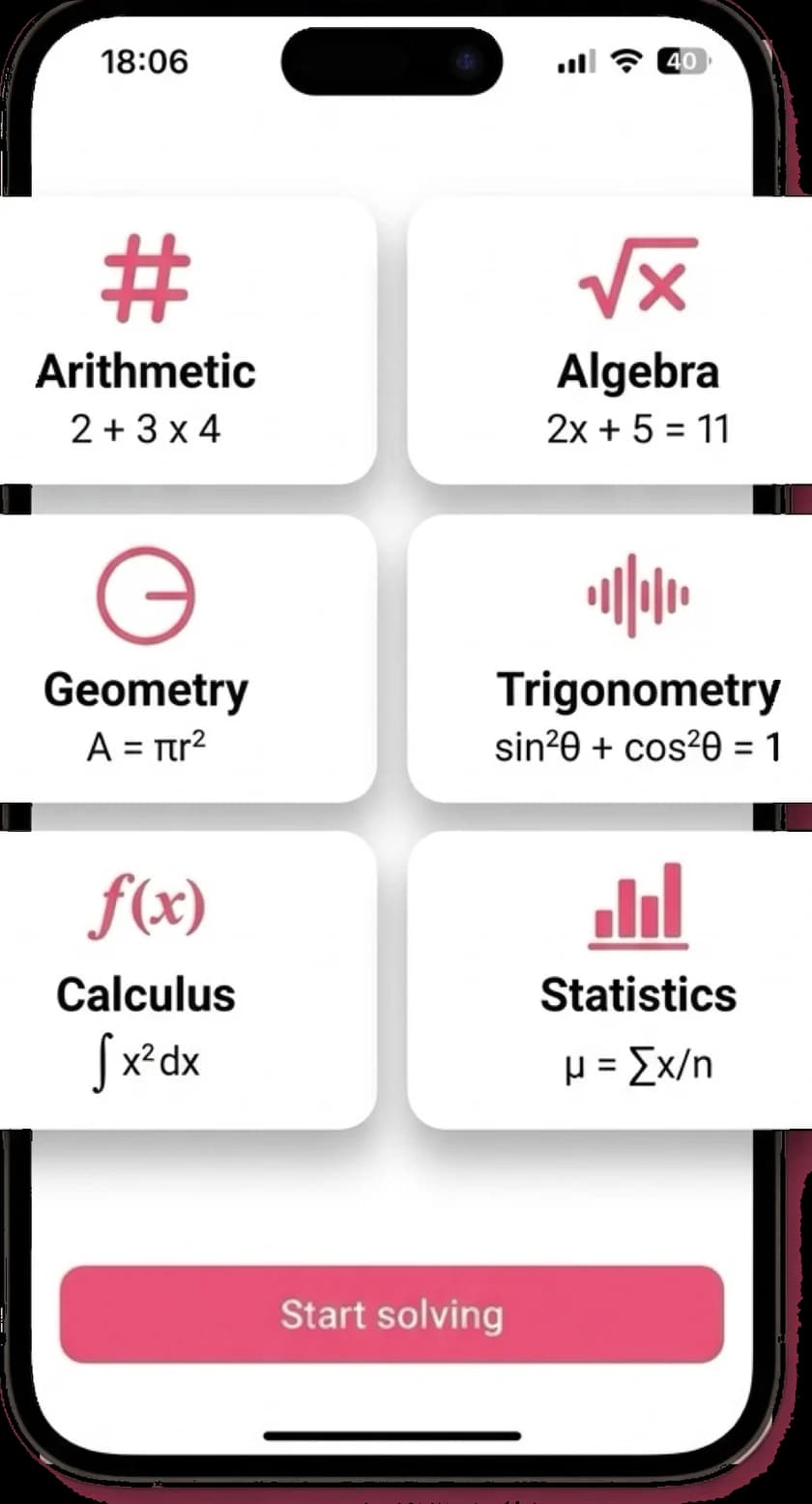
What the calculus solver covers
MathScans covers single-variable calculus, the kind taught in the last years of school and the first year of university. That means limits, derivatives and integrals.
Whichever rule a problem needs, the solution names it on the line where it is used. You see the decision, not just its result.
Limits
- Direct substitution
- Factoring and cancelling
- Limits at infinity
- One-sided limits
Derivatives
- Power rule
- Product and quotient rules
- Chain rule
- Trig, exponential and log functions
Integrals
- Power rule in reverse
- u-substitution
- Integration by parts
- Definite integrals with bounds
A worked integral: u-substitution
Substitution is where most students lose the thread, because the variable changes halfway through. Here is how MathScans works one, step by step.
- 01
Spot the inner function
∫ 2x(x² + 1)³ dx
The bracket x² + 1 is raised to a power, and its derivative, 2x, sits right outside it. That pairing is the signal for a substitution.
- 02
Choose the substitution
u = x² + 1, du = 2x dx
Let u be the inner function. Differentiating gives du = 2x dx, which matches the 2x dx already in the integral exactly.
- 03
Rewrite in terms of u
∫ u³ du
Replace x² + 1 with u and 2x dx with du. What was a messy product is now a plain power of u.
- 04
Integrate with the power rule
u⁴ / 4 + C
Add one to the power and divide by the new power. The + C is the constant of integration, which an indefinite integral always needs.
- 05
Substitute back
(x² + 1)⁴ / 4 + C
The question was in x, so the answer must be too. Replace u with x² + 1 to finish.
And a limit that starts as 0/0
Plugging x = 2 straight in gives 0 divided by 0, which is undefined. That does not mean the limit does not exist. It means the expression needs simplifying first.
Factoring the top shows a common factor of x − 2, which cancels. After that, direct substitution works and the limit is 4.
A good solver explains why it factored instead of just doing it. Spotting the 0/0 case is the skill the question is really testing.
lim x→2 (x² − 4) / (x − 2)
Direct substitution gives 0/0, so simplify first
lim x→2 (x − 2)(x + 2) / (x − 2)
Factor the numerator as a difference of squares
lim x→2 (x + 2)
Cancel the common factor of x − 2
= 4
Now substitute x = 2
Four calculus mistakes the steps make visible
Most lost marks in calculus come from a handful of slips, not from misunderstanding the topic. They are easy to make and hard to spot in your own working.
When every step names its rule, the slip shows up as the line where your working and the solution stop matching. These are the four that come up most.
Chain rule
Dropping the inner derivative
Multiply by the derivative of the inside, every time
Indefinite integrals
Forgetting + C
Every antiderivative needs its constant
Quotient rule
Swapping the terms on top
Bottom times derivative of top, minus top times derivative of bottom
Definite substitution
Keeping the old bounds
Change the bounds to u, or substitute back before evaluating
How to scan calculus notation cleanly
Calculus has more symbols to misread than algebra. Write the integral sign tall enough that it cannot pass for a bracket, and leave a clear gap before the dx.
For a definite integral, put the bounds clearly above and below the sign. For a limit, write the arrow and the value underneath the word lim, not beside it.
Then crop to one problem and check the version MathScans read back. Our math scanner page covers what to do if a scan comes back wrong.
Calculus solvers compared
Every big math app handles calculus. They differ in how you enter the problem, how much working you see for free, and how far past first-year calculus they go.
| App | Input | Steps without paying | Calculus range |
|---|---|---|---|
| Photomath | Photo | Yes, basic | Single-variable calculus |
| Symbolab | Typed, with a camera option | Basic steps | Calculus and beyond, including differential equations |
| Mathway | Photo or typed | No, answers only | Calculus, with a graphing calculator |
| Wolfram Alpha | Typed | Steps need Pro | Very broad, well past school calculus |
| MathScansours | Photo, print or handwriting | 3-day trial | Single-variable calculus |
Checked on each app's US App Store listing and website in October 2026.
If your course goes into differential equations or multivariable calculus, Symbolab or Wolfram Alpha will serve you better than MathScans. Our Symbolab alternative page covers that trade-off.
If you work from handwritten problem sets and want each step explained in words, that is where a camera-first app helps most. The best math solver apps comparison covers the wider field.
What a MathScans calculus solution looks like
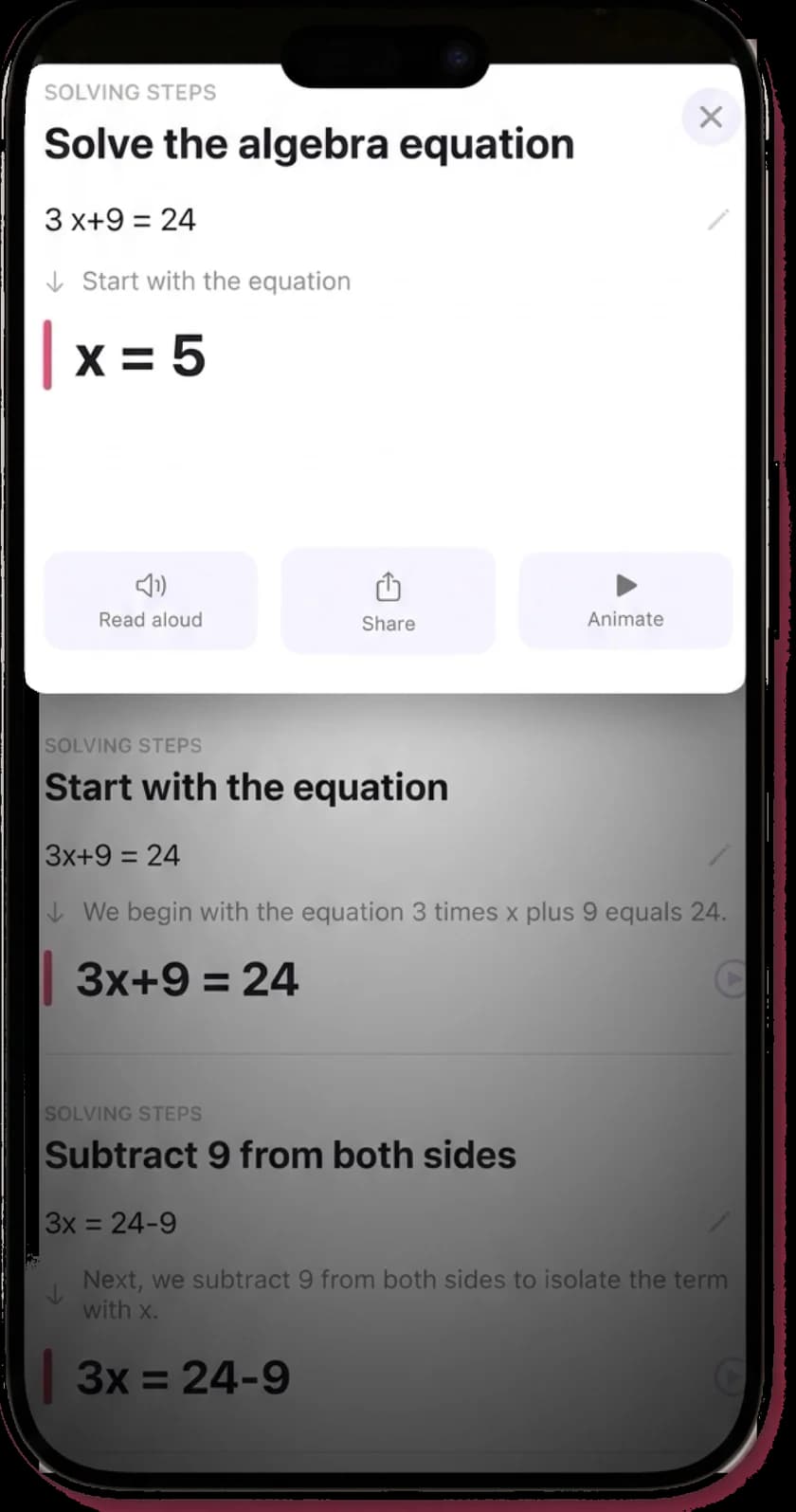
The rule on every line
Each step is labelled with what was done, such as applying the chain rule or substituting back, before showing the result.
That label is what you write in the margin of an exam answer to earn method marks.
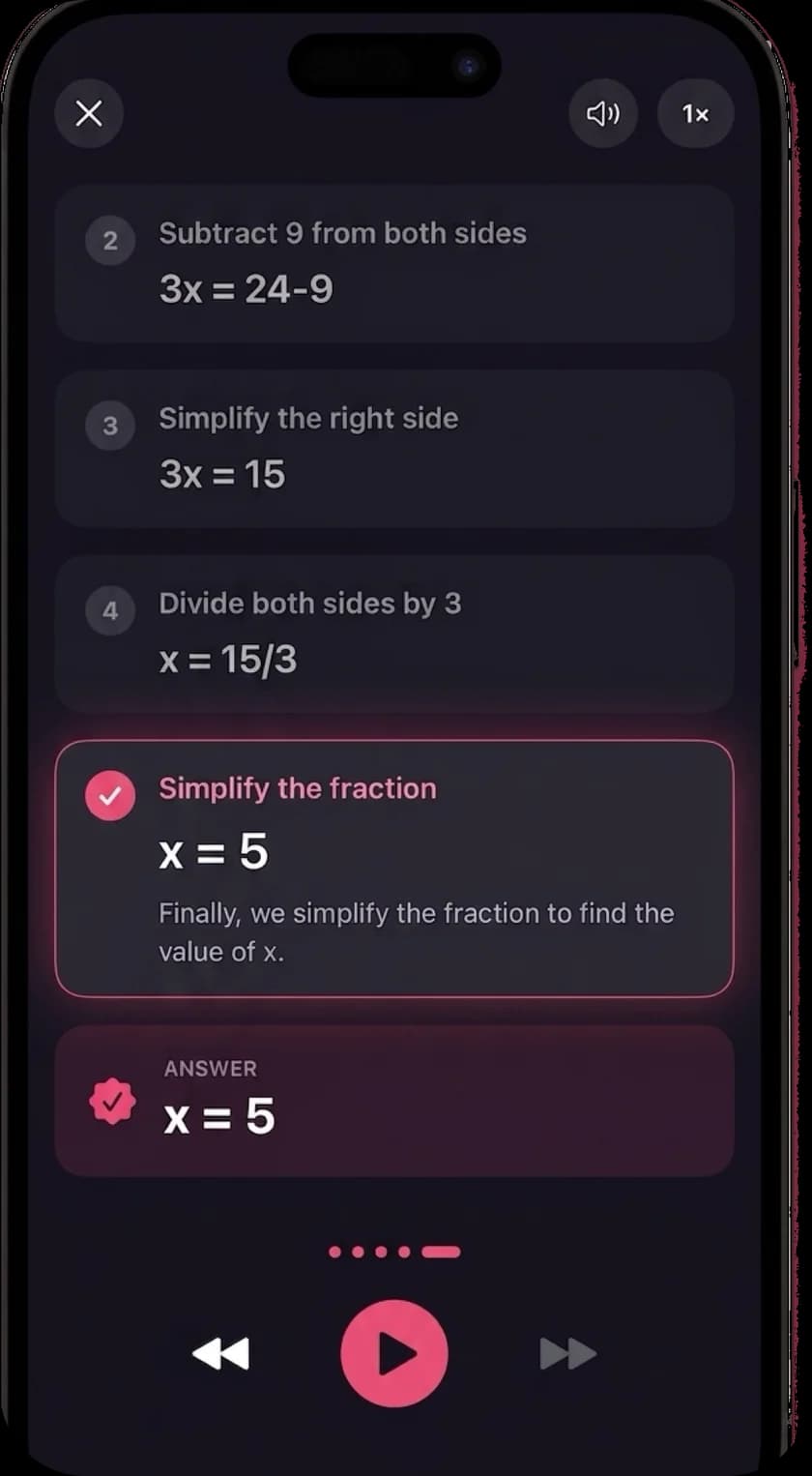
Watch the substitution happen
Substitutions and the chain rule are hard to follow as static lines. The animation shows which terms change on each step, so you can see where the inner function went.
Pause, rewind and replay any step as often as you need.
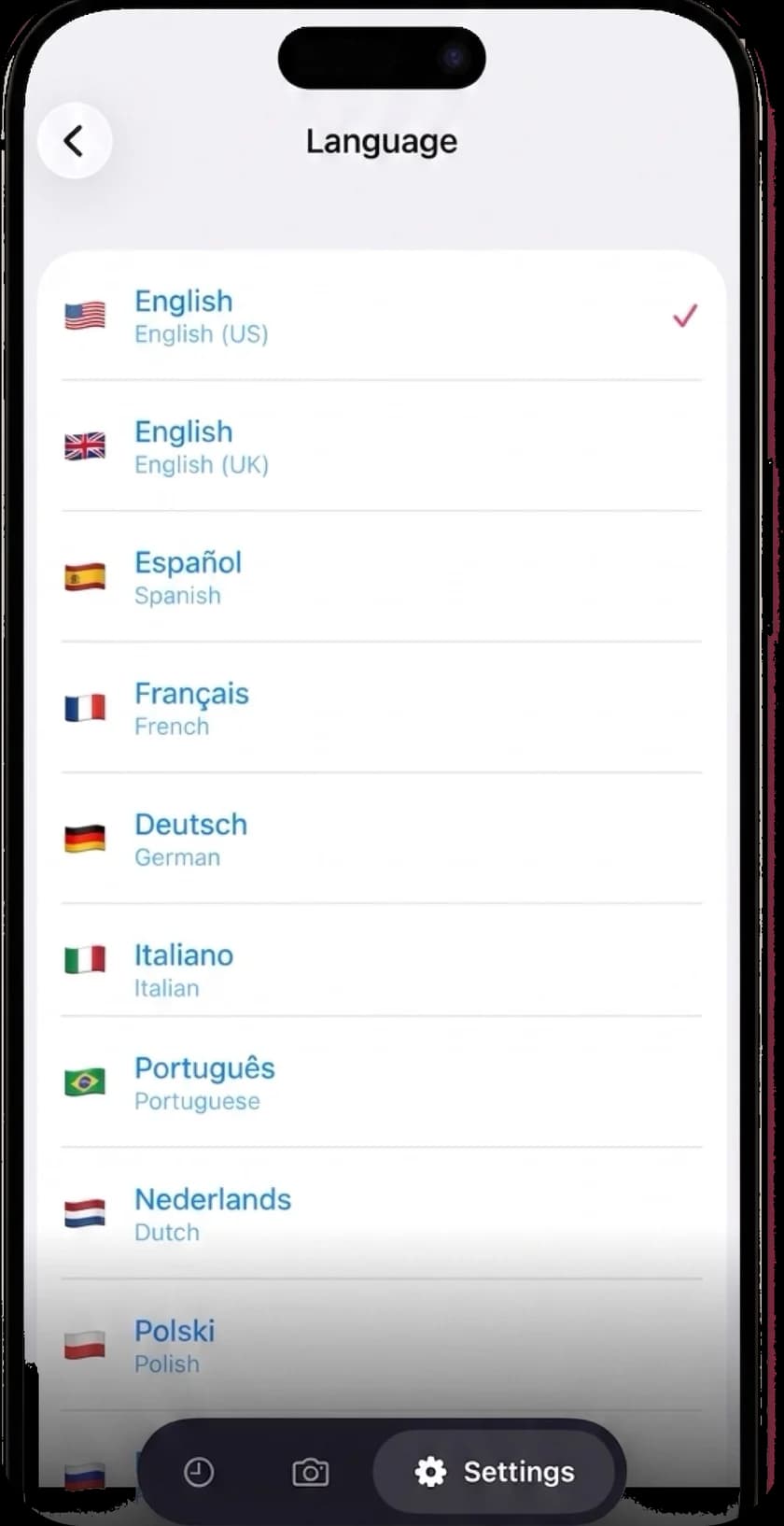
Hear it explained
Read aloud narrates the whole solution in any of 19 languages.
It is useful for revision away from a desk, or if your course is taught in your second language.
Using a calculus solver to revise
Work the problem yourself first, even if you get stuck halfway. Then scan it and find the first line where your working and the solution part ways.
That line is usually a rule you skipped, most often the inner derivative in the chain rule or the + C on an indefinite integral. Note it, then try a similar problem without help.
For a deeper look at the chain rule, our math app for calculus page works a derivative line by line. The algebra and trigonometry solvers cover the skills calculus leans on.
Questions about solving calculus
- Can a calculus solver show steps?
- Yes. MathScans shows every step of derivatives, integrals and limits, names the rule applied on each line and explains why it applies. Photomath and Symbolab show basic steps for free, while Mathway and Wolfram Alpha keep full steps for paying users.
- Does the solver say which rule it used?
- Yes. Every step carries a short label naming the operation, such as applying the product rule, choosing a substitution or cancelling a common factor. Underneath, a plain explanation says why that rule fits this problem, which is the reasoning examiners look for when they award method marks.
- Can I scan a handwritten integral?
- Yes. Write the integral sign tall, keep the dx clear, and put any bounds clearly above and below the sign. Crop to the one integral, then check the problem MathScans read back before reading the solution.
- Does it solve definite integrals?
- Yes. Scan the integral with its bounds and MathScans finds the antiderivative, then evaluates it at the upper and lower bounds and subtracts, showing each step.
- Does MathScans handle multivariable calculus or differential equations?
- MathScans is built for single-variable calculus: limits, derivatives and integrals as taught in high school and first-year university. For partial derivatives, multiple integrals or differential equations, Symbolab and Wolfram Alpha are the stronger choice.
- Can a calculus solver draw graphs?
- Some can. Mathway and Symbolab include graphing tools. MathScans does not draw graphs, so pair it with a graphing tool such as Desmos if a question asks you to sketch a curve.
- Is there a free calculus solver with steps?
- Photomath and Symbolab both show basic calculus steps for free. MathScans is paid, at $9.99 a month with a 3-day free trial, or $4.99 a week, and every explanation is included.
Keep reading
- Math app for calculusDerivatives, integrals and limits, step by step.
- Math solver with stepsHow each step is explained, animated and narrated.
- Algebra solverEquations, factoring and systems, explained.
- Trigonometry solverIdentities, triangles and the unit circle.
- Symbolab alternativeScan instead of type, with every step included.
- Photo math solverTake a picture of a problem and get every step.
Scan tonight's integral. Follow every step.
Try MathScans free for 3 days on the monthly plan. After that it is $9.99 a month or $4.99 a week. Cancel any time in Settings.