Calculus, with the working shown
A math app for calculus that shows the chain rule, not just the answer.
Scan a derivative or integral with your iPhone camera and get the full working: the rule applied on each line, why it applies, and an animation of the terms moving. Built for the steps you have to reproduce in the exam, not just the final result.
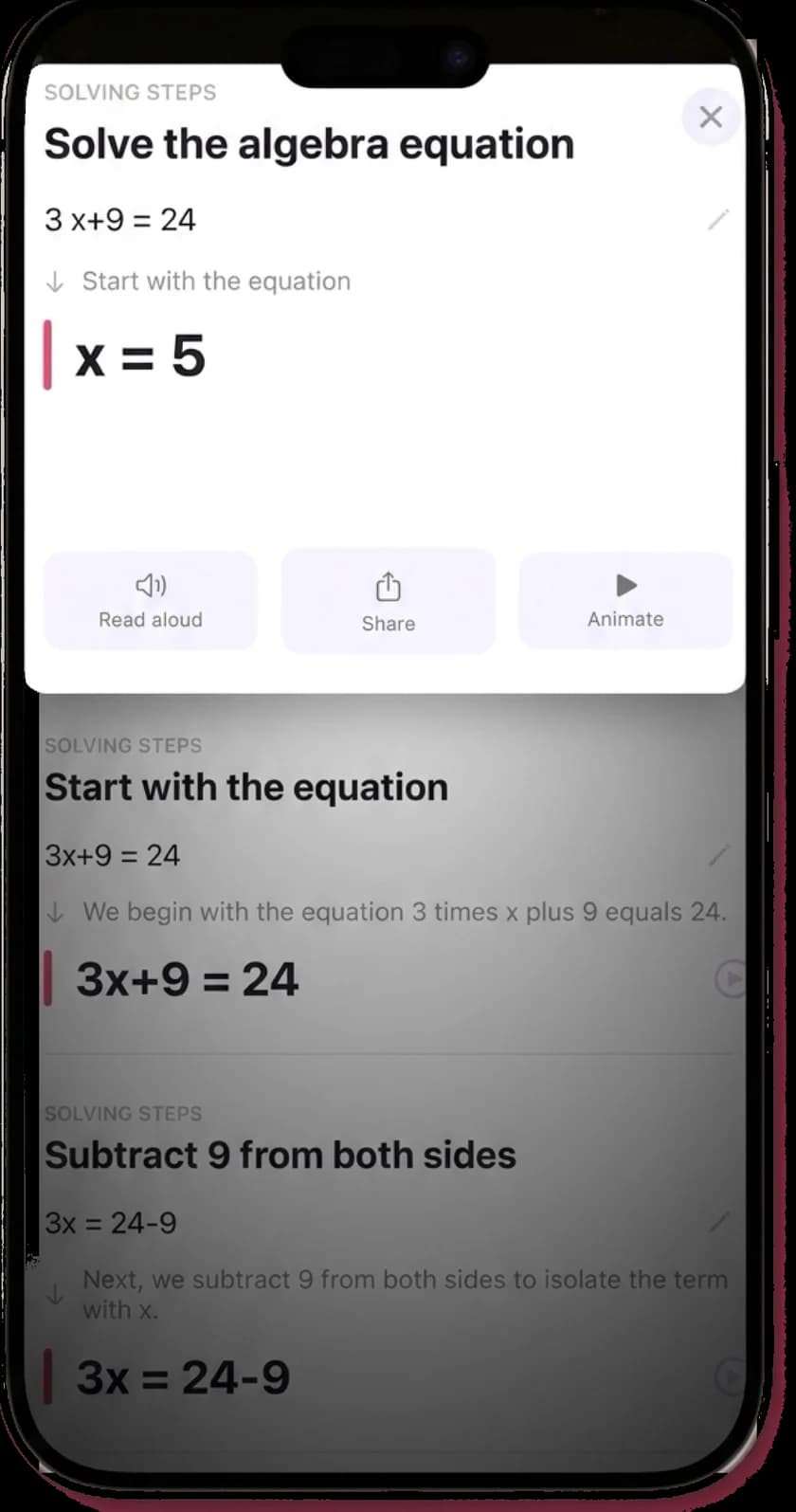
A worked derivative
The chain rule, step by step.
Differentiating (2x + 1)³ is the classic place a calculus app either helps or just hands you an answer. Here is the whole of it as MathScans presents it, so you can judge the depth before downloading anything.
- 01
Read the expression as a composite
d/dx (2x + 1)³
There is an inner function, 2x + 1, raised to a power. That nesting is what makes it a chain-rule problem rather than a plain power-rule one, and naming it first is what stops the common mistake in step two.
- 02
Apply the chain rule
3(2x + 1)² · d/dx (2x + 1)
Differentiate the outer power first: bring the exponent down and reduce it by one, leaving the inside untouched. Then multiply by the derivative of the inside. Forgetting that second factor is the single most common calculus slip, so the step is spelled out rather than assumed.
- 03
Differentiate the inner function
3(2x + 1)² · 2
The derivative of 2x + 1 is 2, because the derivative of 2x is 2 and the derivative of a constant is 0.
- 04
Simplify
6(2x + 1)²
Multiply the constants, 3 times 2, to get 6. That is the derivative, and every marking scheme wants to see the chain-rule line above it.
Where solvers get tested
Every app looks fine on a linear equation.
Arithmetic and basic algebra are the easy case, and every solver handles them. Calculus is where they separate: nested functions, substitutions, and notation the camera has to read correctly before any working can begin.
So before you subscribe to anything, run the honest test. Scan a real integral from your current unit, not the tidy demo in the App Store screenshots, and check two things: that the app read the notation correctly, and that the steps are ones you could reproduce under exam conditions.
MathScans covers single-variable calculus, names the rule on every line, and animates the step so a substitution is something you watch rather than something you infer from a static line of algebra.
Built for the calculus student who wants to understand it.
MathScans is focused, and that focus is the point. It is built for single-variable calculus on iPhone: limits, derivatives and integrals scanned from your own handwriting, each step explained and animated so the working sticks. If that is the course you are in, this is an app designed around exactly your problem.
Start free for 3 days on the monthly plan and put it straight onto your own coursework. Scan tonight's problem set, follow the chain-rule and substitution steps, and decide for yourself, before you are charged anything, whether the explanations are clearer than what you are using now.
Questions about calculus apps
- Is Photomath good for calculus?
- For single-variable calculus it is capable. Photomath handles derivatives and integrals and shows steps, and its free tier includes step-by-step working, so it is a fair first thing to try. Where camera solvers in general get weaker is dense or multi-line calculus notation and word-heavy problems, so whichever app you pick, scan one real question from your own problem set before you rely on it.
- What is the best math app for college calculus?
- There is no single answer, because college calculus covers a wide range. For typed input and higher-level algebra and calculus, Symbolab is strong. For scanning handwritten work and following each step with a plain explanation, that is what MathScans is built for. The honest test is not the App Store screenshots but a real integral from your current unit: scan it in the free tier or trial and check that the working is something you could reproduce in an exam.
- Can a math app solve integrals and derivatives with steps?
- Yes. MathScans shows the full working for differentiation and integration, naming the rule applied on each line, such as the power rule, chain rule, product rule or a substitution, and explaining why it applies. The animated player then replays the step so you can watch the terms move, which helps most on chain-rule and substitution problems where a static line hides what actually happened.
- Which calculus topics does MathScans cover?
- Single-variable calculus in full: limits, differentiation and integration, with every step explained and animated, alongside the algebra, trigonometry and pre-calculus that lead into them. That covers the calculus most high-school and first-year college courses set. The 3-day trial lets you scan your own coursework and confirm the fit before deciding.
- Is using a calculus solver cheating in college?
- It depends on how you use it, and it is worth being clear-eyed about. Submitting a solved integral as your own worked answer is cheating. Getting stuck on a substitution, reading the explanation of the step you missed, then reworking the problem yourself is ordinary studying, the same as using a worked example in the textbook. Course policies differ, so if an assignment is graded, check what your instructor allows.
Test it on your next integral.
Scan a derivative or integral, read the working, watch it animate. Free for 3 days on the monthly plan, then $9.99 a month.